


 Back
BackHow to Spot, Report & Prevent Scam Calls
Stay safe from scam calls in Singapore! Learn how to recognise and report them using the ScamSafe app.
What’s the first thing that comes to mind when an unknown number pops up on your phone?
Chances are, you’d think: “It’s a scam call.”
And you’re probably right. Scam tactics have only grown craftier and bolder in recent years, with over $1.1 billion lost in 2024 alone, according to a February report by The Straits Times. It’s a serious issue—and one we must be ready for.
From sneaky “friends” who’ve just changed phone numbers to “helpful” bank representatives showing up out of the blue, let’s take a closer look at how we can better spot and report scam calls in Singapore.
📍Quick Navigation
In a hurry? Hop over to a specific section!
📈 Quick Stats on Scams in Singapore for 2025 (up next!)
Quick Stats on Phone Scams in Singapore (2025)
A handy snapshot of scam activity in Singapore for the year thus far.
- Over 9,500 total scam cases were reported in Singapore in the first quarter of 2025, with more than 36% of them (3,400+) occurring in March alone. More than S$224 million has already been lost as a result of these.
- Impersonation scams remain widespread, with banks and government agencies frequently used as covers. Scams involving Chinese services like Tencent have also recently surfaced—with over 265 cases reported in February 2025. These have led to a collective loss of over S$5.6 million.
Note: These figures represent total reported scam cases in Singapore across all formats (calls, SMS, messaging apps, etc.) unless specified. Information courtesy of The Straits Times and the ScamShield website.
📞 What are Scam Calls?
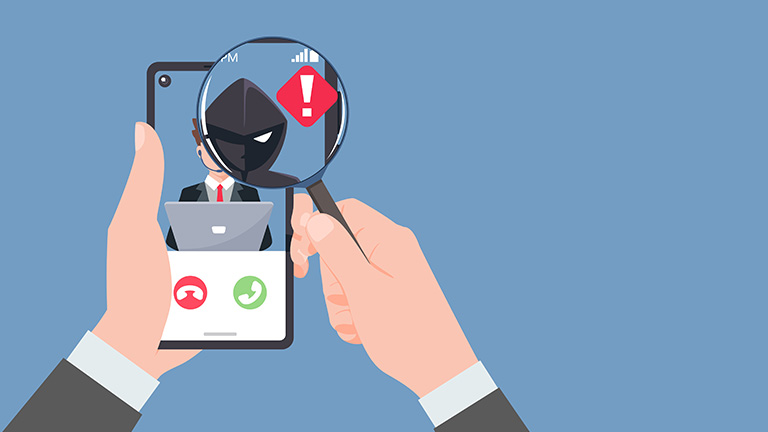
Broadly, scam calls are just one of many types of fraud. Scammers pose as trusted figures to deceive victims, with the deception typically carried out over voice or video calls.
Common Types of Scam Calls in Singapore
As of end-March 2025, Singapore recorded over 9,500 scam cases, totalling more than S$224 million in losses. According to the Singapore Police Force (SPF), over 3,400 of those cases—around 36%—happened in March alone.
Although the website doesn’t specify how many of these cases were scam calls, what we do know is that they can come in many different forms. Here are how some of the more commonly reported scam call types operate:
- Government Impersonation Scams
Here, scammers pose as representatives of government agencies such as the SPF or the Inland Revenue Authority of Singapore (IRAS). These scams often involve emotional pressure or urgency to get victims to act quickly.
- Bank Impersonation Scams
Scammers impersonate bank representatives, claiming that there are urgent concerns with the victim’s account—such as potential fraud or suspicious activity. These calls often occur during business hours, sound professional, and may even include requests to “verify” sensitive details.
- Fake Friend Call Scams
In this type of scam, the scammer pretends to be a long-lost friend or one that has recently changed their phone number. By pretending to be someone the victim knows, the scammer aims to establish rapport, then ask for help with requests involving money or account details.
🚩 What are the Telltale Signs of a Scam Call?
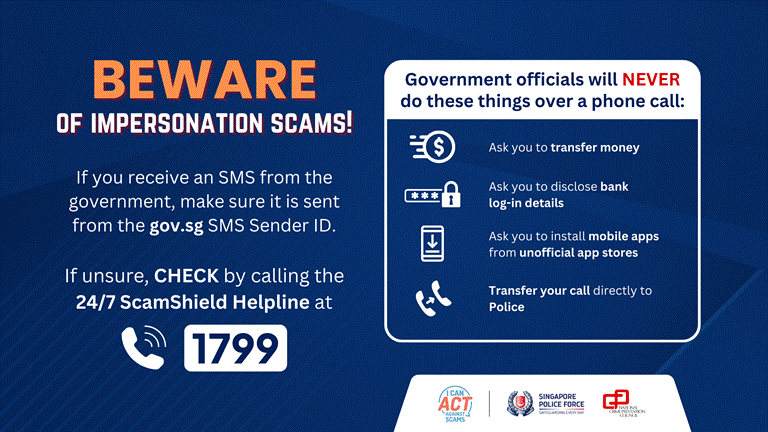
Source: ScamShield website
Now that we know what they are, how can we better recognise scam calls?
Here are a list of red flags you’ll want to be wary of when there’s an unknown number on the other end of the line. If one or more of these are present, it may be a scam call.
Does the caller…
- Threaten to arrest you, or repeatedly urge you to perform a particular action as quickly as possible?
- Claim to be from a government agency or bank but also avoid providing verifiable contact information?
- Ask for sensitive information like your NRIC number, bank account details, OTPs, or SingPass credentials?
- Request money transfers to “secure” your account, “verify” your identity, or resolve supposed legal issues?
- Originate from an unfamiliar or international number – or from a local number that doesn't match official contact lines?
- Tell you not to hang up or speak to anyone else on the matter?
- Ask you to download an app or access suspicious links from non-official app stores or unfamiliar sources?
- Sound overly scripted, robotic, or inconsistent?
- Appeal to you using emotions like fear, guilt, or sympathy?
- Claim to involve the police in an attempt to scare or pressure you?
👮 How to Report Scam Calls in Singapore
Saw a suspicious number and declined the call right away? That’s a smart move. Unfortunately, because this threat is constantly shifting and evolving, you’ll want to have as many strong defences set up as possible.
Below, we’ve provided some helpful tools you can use to better protect yourself and your loved ones, such as our newest anti-scam offering, ScamSafe.
1. Download the ScamSafe App
Developed in partnership with TrustTech provider Gogolook, ScamSafe is StarHub’s very own anti-scam mobile app that anyone can download and use. Featuring a multitude of helpful features, from call and SMS filters to scam databases and even reporting channels, it’s truly an amazing tool to have in your corner. Here’s a sneak peek of what it can do:
- ✅ Call and SMS Filters
Did you know that simply having ScamSafe set up on your phone automatically protects you from the bulk of suspicious messages and calls?
That’s right. Among the app’s many nifty features are a set of scam call and SMS filters, which can swiftly detect any such calls and texts and send them straight to the digital trash heap. What’s more, this is all done 24/7 without you needing to lift a finger, leaving you free to spend time on other pursuits.
On top of this round-the-clock monitoring, you can even set up some extra layers of security using the app’s custom keyword filters. These can be configured to target common scam-associated phrases such as “urgent payment,” or “lucky draw”, making it absolutely perfect for vulnerable demographics like children or the elderly.
After all, if ahma never sees the scam message or engages with the fraudulent caller, she’s significantly less likely to be misled!
- 🔄 Updated Scam Database
But how does ScamSafe know what messages and texts are potentially scams? Well, it’s equipped with an extensive (and regularly updated!) database of registered scam numbers, which subscribers can also contribute to by making simple in-app reports. This database even comes with an in-built number lookup, making it easier than ever to identify dodgy callers.
Want to take ScamSafe for a spin? We’re giving everyone a 6-month free trial! Existing StarHub subscribers can subscribe to it conveniently via the StarHub App, while non-subscribers can download it via the App Store and Google Play Store respectively.
After the free trial window, subscriptions will be priced at $2.99/mth for StarHub subscribers and $4.99/mth for non-subscribers.
2. Submit a Report via the SPF’s i-Witness Portal
If you’ve received a scam call or message, you can report it online through the SPF i-Witness portal to help law enforcement monitor scam trends and warn others.
However, do take note that both ScamSafe and i-Witness Portal reports are NOT official Police Reports. If you believe you’ve been scammed, the best step forward is to file one online via the SPF’s e-Services portal or in person at your local Neighbourhood Police Post.
👉 SPF i-Witness Portal
👉 SPF e-Services Portal (if you need to file an official Police Report)
🌟 Stay Scam-free with StarHub!
In a world where scam tactics are continuously evolving, vigilance is crucial to keeping us and our loved ones safe.
By being aware of the red flags and equipping yourself with helpful apps like ScamSafe, you can make things much safer for both you and the community at large. So, if something feels off about that call or message, it’s best not to entertain it.
Want to learn more about scams in general and how to thwart them? Make sure to check out our Scam Masterclass series, which we've worked on in collaboration with the Singapore Police Force!
